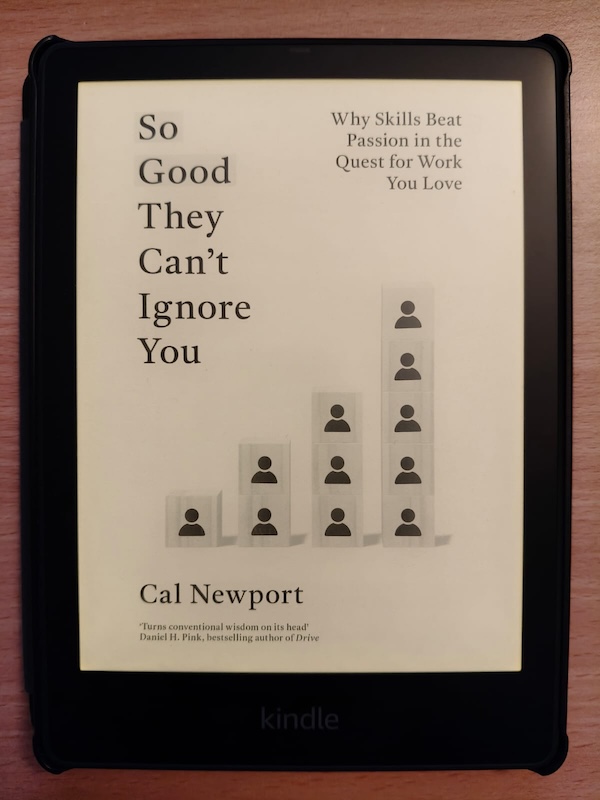
So Good They Can't Ignore You by Cal Newport
by Željko Filipin
tags: book · image · productivity
Estimated reading time is 6 minutes.
Introduction
Cal Newport is one of my favorite authors. I have read almost all of his books. Some of them several times. I also really like his podcast Deep Questions.
I have read this book at least two times. I have listened to it in late 2022 as an audio book and I have read it in early 2025 as an ebook.
I wish I had read this book when I was much younger. Probably in high school. I hope my kids read it in high school.
2025 was really busy. I wanted to write a review of the book earlier. I usually have the time to write one blog post every month. So, this book never made it to the short list. Until now.
The Book
The book has four sections. Each section has several chapters. Each section discusses one rule.
- Rule #1: Don’t Follow Your Passion
- Rule #2: Be So Good They Can’t Ignore You (Or, the Importance of Skill)
- Rule #3: Turn Down a Promotion (Or, the Importance of Control)
- Rule #4: Think Small, Act Big (Or, the Importance of Mission)
Quotes
After exporting my Kindle highlights, I got an eleven page pdf document. I have highlighted a lot. I’ll select just a few quotes.
Chapter One: The “Passion” of Steve Jobs
The Passion Hypothesis
The key to occupational happiness is to first figure out what you’re passionate about and then find a job that matches this passion.
(Page 4.)
Before reading the book, I thought this was the only way. I know better now.
Chapter Five: The Power of Career Capital
The Career Capital Theory Of Great Work
- The traits that define great work are rare and valuable.
- Supply and demand says that if you want these traits you need rare and valuable skills to offer in return. Think of these rare and valuable skills you can offer as your career capital.
- The craftsman mindset, with its relentless focus on becoming “so good they can’t ignore you,” is a strategy well suited for acquiring career capital. This is why it trumps the passion mindset if your goal is to create work you love.
(Page 48.)
The combination of rare and valuable is the key. If something you can do is just rare, or just valuable, it’s not enough.
Three Disqualifiers For Applying The Craftsman Mindset
- The job presents few opportunities to distinguish yourself by developing relevant skills that are rare and valuable.
- The job focuses on something you think is useless or perhaps even actively bad for the world.
- The job forces you to work with people you really dislike.
(Page 56.)
When selecting a job, you don’t have to be really picky. There are just a few things that would make a job bad.
Chapter Seven: Becoming a Craftsman
There are two types of these markets: winner-take-all and auction.
(Page 91.)
I was not aware of these two markets. The world makes more sense now.
Chapter Eleven: Avoiding the Control Traps
The Law of Financial Viability When deciding whether to follow an appealing pursuit that will introduce more control into your work life, seek evidence of whether people are willing to pay for it. If you find this evidence, continue. If not, move on.
(Page 139.)
It’s pretty easy to get positive feedback from people. It’s very hard to get money from people. If people are willing to pay for something, you have struck gold.
Popular Highlights
This Kindle feature fascinates me. What have other people highlighted? It’s probably important. I could not find any official documentation about it. What I did find is that a lot of people hate it.
Introduction
In other words, you need to be good at something before you can expect a good job.
(4k+ highlighters.)
A word of warning for people entering the job market.
Chapter Two: Passion is Rare
Compelling careers often have complex origins that reject the simple idea that all you have to do is follow your passion.
(Page 13. 4k+ highlighters)
My career is a perfect illustration of this.
Autonomy: the feeling that you have control over your day, and that your actions are important
Competence: the feeling that you are good at what you do
Relatedness: the feeling of connection to other people
(Page 18. 5k+ highlighters.)
The more I think about this, the more it sounds correct.
Chapter Three: Passion is Dangerous
The more we focused on loving what we do, the less we ended up loving it.
(Page 23. 3k+ highlighters.)
It’s similar to relationships. It’s not enough to focus only on picking the right person. It’s very important to work on the relationship once you have found the right person.
Chapter Five: The Power of Career Capital
You need to get good in order to get good things in your working life, and the craftsman mindset is focused on achieving exactly this goal.
(Page 49. 4k+ highlighters.)
The world doesn’t owe you anything. You have to deserve it.
Chapter Seven: Becoming a Craftsman
It is a lifetime accumulation of deliberate practice that again and again ends up explaining excellence.
(Page 84. 4k+ highlighters.)
This is probably not something you want to hear at the beginning of your career. It’s something you’ll agree with later in life.
Doing things we know how to do well is enjoyable, and that’s exactly the opposite of what deliberate practice demands.… Deliberate practice is above all an effort of focus and concentration. That is what makes it “deliberate,” as distinct from the mindless playing of scales or hitting of tennis balls that most people engage in.
(Page 96. 3k+ highlighters.)
It’s sobering when you realize you have hit a plateau in something. Be it running, chess, guitar, coding… The time of being comfortable is over. It’s time to train hard again.
Chapter Eight: The Dream-Job Elixir
Giving people more control over what they do and how they do it increases their happiness, engagement, and sense of fulfillment.
(Page 113. 4k+ highlighters.)
To summarize, if your goal is to love what you do, your first step is to acquire career capital. Your next step is to invest this capital in the traits that define great work. Control is one of the most important targets you can choose for this investment.
(Page 114, 3k+ highlighters.)
I have not realized, until recently, how motivated I am when I have a hard goal to reach, and enough control to try different approaches to reach it.
Chapter Twelve: The Meaningful Life of Pardis Sabeti
Hardness scares off the daydreamers and the timid, leaving more opportunity for those like us who are willing to take the time to carefully work out the best path forward and then confidently take action.
(Page 154. 3k+ highlighters.)
I am amongst “the daydreamers and the timid” in several things that are important to me. I am amongst a few that are “confidently taking action” in a few things that are important to me.
Feedback
Thank you for reading. If you want to stay in touch please use the feed or send me an email.